
An email conversation with a fellow collector recent alighted upon the topic of "The Assassination of President Kennedy", the folder (not book) of essays and pictures about the assasination of the US president compiled and designed by Michael Rand, Howard Loxton and Len Deighton.
The conversation was prompted by seeing an eBay listing for a pristine, signed copy of the Jackdaw Folder, valued at over £1,000! The price perhaps reflects that it's signed by the author, but even so, it's pretty steep. As a collector I've been tempted many times to pay over the odds for a rare Deighton, but that took my breath away. I fear the seller may have to temper their outlook.
Nevertheless, it prompted me to take my copy off the shelf, and look at it again, something I haven't done for a number of years in point of fact. And, to consider its value as a 'book', a collectable item, and its place within the wider canon of Deighton books.
It's one of the favourite items I own with a Deighton collection, for many reasons. It's format is unusual, and well designed. It's an interesting subject matter. It's rare, which is always a draw for a collector. And, perhaps, given the subject material, it's an even-handed attempt to address the most controversial of topics for which there are a thousands of books all telling a different angle on the story.
If you've only read Deighton's novels, you may not be aware of this unusual entry in his catalogue. Let's explore it further.
What is it?
This item is certainly an outlier in Deighton's catalogue. For a start, it's not a book. It's a folder, containing a number of loose-leaf items pertaining to the 1963 assassination, thematically presented to provide the reader with the basic information about the case and an insight into the discussion around it. These are:
- A scale model in card paper of Deeley Plaza, which the reader can build to better understand the mise en scene of the assassination
- A facsimile of an anti-Kennedy poster circulated in Dallas
- A photograph of the assassination
- A summary of the autopsy report included in the Warren Commission
- Illustrations of the President's wounds
- The FBI report on the autopsy
- A descriptive sheet of the autopsy
- A photo of the President's bloodied shirt
- Jackie Kennedy's official testimony to the Warren Commission
- Warren Commission document 767
- An advertisement for the rifle used by the assassin
- A reproduced of the alleged weapon
- A list of questions raised by the evidence
- Five broadsheet essays covering the different aspects of the case.
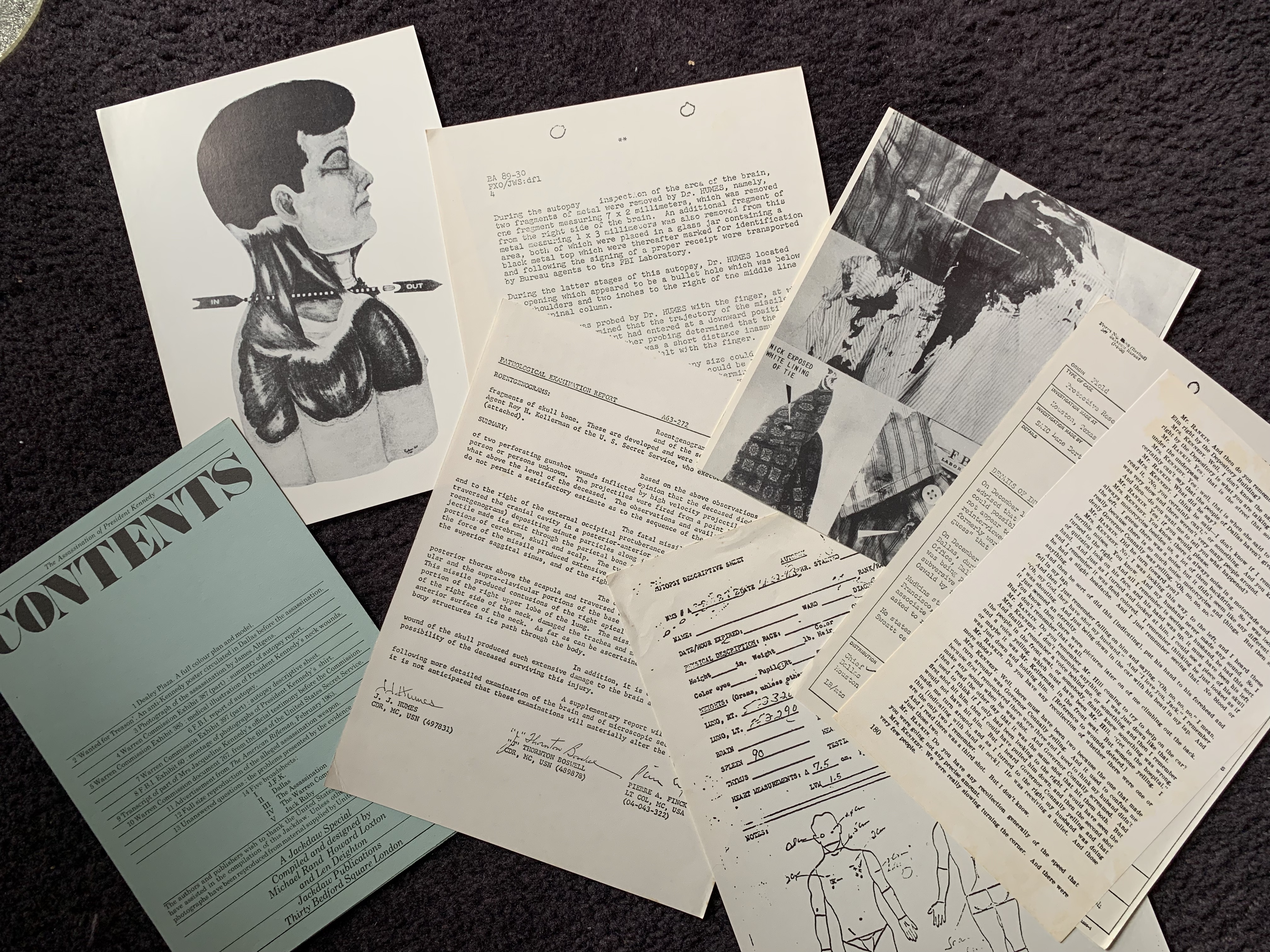

However, it's not by any means a source of information for conspiracy nuts. It's a reasoned, well put-together and interesting alternative to a dense book, for someone coming to the subject first time, such as school children.
Who contributed?
Len Deighton is one of three authors. Michael Rand was the Sunday Times Magazine's art director for thirty years, someone who would have been known to Deighton as a fellow graphic designer and from his time working on a number of feature articles in the same magazine.
As to Howard Loxton, the third contribution, an online search didn't produce anything concrete as to his connection to the other two authors, or his wider contribution to literature and design. (If any blog readers can thrown any light on him, do please add a comment). My suspicion is that, like Rand, he too was involved in the publishing or magazine world, so likely a companion of the author.
It's not clear which specific elements or essays Deighton wrote - the one about Jack Ruby perhaps, or the broadsheet on the Warren Commission? The likelihood is that they probably wrote it collectively, as the style seems consistent across all the content; that is, there isn't any one thing that stands out like a passage from a Deighton book.
In the separate notes on the exhibits, each one has several paragraphs of explanatory text, giving more detail about each aspect of the assassination and the subsequent investigation, which concluded - famously - that the killing was the responsibility of Lee Harvey Oswald. The whole thing feels thorough, a trait one associates with Len Deighton's non-fiction historical writing, certainly.
Who was its target audience?
Thirdly, the format is largely targeted at schoolchildren and teachers, not the regular reader. It's an educational tool, but clearly for a high or secondary school level; perhaps as part of a history or civics class. The intention with a folder was clearly to have something which could be opened and shared by pupils around a table or on a bench: exchanged, discussed, and examined.
Only 1,500 of the original edition were ever produced, and few are found in perfect mint condition or indeed complete. Not surprising, given that most will have ended up in educational settings and - well, you know kids - have had parts lost or written or, or the diorama would have been punched out and assembled.
The collection as a whole does present a single opinion or viewpoint; rather, it lays out the facts in front of the reader in an interesting and visually appealing way, and was clearly designed to allow the reader/class to draw their own conclusions rather than a single viewpoint. However, it is clearly drawing a lot on the conclusions of the Warren Commission, so there is little consideration of more outré theories of the assassination.
What's the best bit?
Undoubtedly, it's item number 1, a military green foolscap folder containing the pieces for a cardboard cut out diorama of Deeley Plaza in Dallas. As well as instructions for pushing out each element from the cardboard and assembling it, it contains a guide to the key positions in the model.
Children were encouraged to build it and use it clearly as a discussion point for the lesson. My own copy is mint and complete and contains the mini open-top car in which the President rode (this tiny piece is often missing in other copies of the folder I've seen; understandably so, given its size).
I've often felt tempted to assemble the model, to see how it looks when completed. But then the collector in me takes over: a pristine, non-assembled version of model is crucial to maintain the integrity of the item; it's the sort of thing collectors will look out fore.


What do we know about the publisher?
Jackdaw Publications is a US-based educational publishing company specialising in primary source documents; indeed, the company is still publishing.
The edition I own was published in the UK through a Jonathan Cape/Jackdaw tie-up (Cape was Deighton's publisher already by 1967, when this folder was produced), but I think the version available in the US is pretty much the same item.
On the back of the blue contents document is a list of other similar Jackdaw folders. They cover a diverse range of topics, from The Battle of Agincourt to Joan of Arc, from The Armada to The Crimean War (my copy is, clearly, the UK edition).
Is it collectable?
Perhaps because of the association with Deighton, this has become the rarest and most collectable of the hundreds of Jackdaw folders produced.
If you want to avail yourself of a copy - and don't fancy shelling out £1,000+ on eBay - then this page of the Jackdaw Publications website indicates that facsimiles of the 'sixties original folder are still available to purchase (albeit, without the Presidential Seal on the back of the original). There is even (isn't there always, nowadays) a Facebook group associated with the Jackdaw phenomenon; for many people who went to school in the sixties and seventies, these Jackdaw folders were, evidently, quite the thing.
The verdict
It's interesting; a rarity. And oddly out of sync with the trajectory of Deighton's career at the time of publication (1967), by which time he's already published the first Harry Palmer novels, and The Ipcress File and Funeral in Berlin had already been turned into movies.
So, as an author he was very much on the up at time of publication, which makes the decision to contribute to what is essentially a school textbook quite intriguing. He didn't have to, but more likely he wanted to as he was interested in the topic, it was timely, and he was helping out friends and colleagues.
Whatever the reason, it's a fascinating piece of ephemera that is still available from time to time online, and certainly at prices far below the listing linked to above.


Interesting you say it is for children. I'm 54 and it sounds fascinating.
ReplyDeleteI'm sure that fact reflects badly on either you, me or Mr Deighton. it is probably best not to think about which too hard...
I am not surprised about this ebay offer.
ReplyDeleteIt is pitching to a human weakness called obsession. There is a thin kine between special interest and obsession/addiction.
I am glad that I did not cultivate it. During the late 1950s and early 1860s, I owned a few hardbacks of Fleming’s novels_Dr No and From Russia with Love, purchased to read when they were first published. Similarly about Deighton’s first publications of The Ipocress File and Funeral in Berlin. They were interesting to read and understand the place of Britain before the Cold War and when the Cold War was in full swing. But I knew that the world was moving fast, and it is best that I also move on. I gave them away to my friends, knowing fully well that one day, they will become collectors’ items. I did not want to get trapped into an obsession about one author or another. What Deighton did was to create a curiosity about the Cold War played out in the two Berlins. Later in early 1980s, when I had a chance to take part in an academic conference in Dresden, I jumped at the chance,visited West Berlin cross the Wall to the East Berlin on the way to Dresden.
About JFK assassination. I heard it in my tiny radio at my bedside-I was in my final year of my university studies. It was the biggest news in the dying days of the Autumn 1963, arguably the most watched when the story was presented in several ways in the media. The first thing I did after I arrived in the USA in early 1970s to study and work was to visit Dallas,tosee the route that JFK did and to go in to the Book Repository. The event- pre and post stories were analysed , debated and later forgotten by early 1970s , when Texans moved on. The new story then was about the Moon landing.
Years later,in 1990s, and in 2000, I had occasions to visit Dallas to take part in academic conferences. My academic colleagues in the SMU in Dallas did not evince much interest, when I mentioned JFK’s visit there which ended in his death! They said, the life moves on!
Yes, the life moves on I am glad that I ditched those books. They served a purpose at one time, and no more. These days I equally enjoy reading Baldacci , Coben and Lee Child, all as e-books. Hence, I am not tempted by offers like this or any other item linked to a specific author. Makes the life simpler !
Having recently rewatched the Ipcress File TV series I find an interesting connection here.
ReplyDeleteSome of us thought that incorporating the Kennedy assassination into that version was a step too far but now we see Len was on to it from the start :)
As Greg Parker notes, there are some details about the Prayer Man one has to know. Firstly, the name of the person is wrong. He did not have his hands held together in prayer. It is an optical illusion caused by his arms being folded and his bare elbow reflecting in the large glass pane behind him. The name stuck.
ReplyDeleteSecondly, any Corroborating documents and testimony are the testimony of Harry Holmes:
"He said, "I went down, and as I started to go out and see what it was all about, a police officer stopped me just before I got to the front door, and started to ask me some questions, and my superintendent of the place stepped up and told the officers that I am one of the employees of the building, so he told me to step aside for a little bit and we will get to you later. Then I just went on out in the crowd to see what it was all about."
This matches what is contained in Commission Document 81.1
"As each office and floor was cleared, the employees were stopped by [Lt.] Kaminski and Mr. Truly, manager of the firm, at the front door where there names, addresses and telephone numbers were written down, and they were identified by Mr. Truly as to their employment..."
The list of names obtained by Kaminski with Truly's help was later typed and given to Lt. Revill. At the op of the list is Lee Harvey Oswald showing his address as 605 Elsbeth. Oswald did not drive and only carried one piece of ID that contained an address. This was his library card - which he had on him at the time of arrest. This card had his old Elsbeth St address on it. NO arresting officer ever claimed Oswald gave his address as Elsbeth - nor did any arresting officer say they took his address as Elsbeth from his wallet. By default, Oswald must have shown this card to Kaminski to end up on that list.
The report referencing the efforts of Kaminski and Truly were in turn verified in the testimony of Buell Frazier
"...we had to give proper identification and after we passed him he told us to walk on then to the next man, and we, you know, put down proper information where he could be found if they wanted to see you and talk to you any more, and then we went on up to a little bit more to the front entrance more toward Mr. Shelley's office there with another man and stood there for a little while and told us all that was there could go ahead and go home...
According to offical investigators, Oswald was long gone when this process was taking place. The only way he could have known about it is if he was there and went through it.
There are also the hand-written notes of FBI Agent Hosty who sat in on the first interogation and kept his notes against FBI policy. In these notes, Hosty states that "Oswald said at lunchtime he went to the second floor to get a cola to have with his lunch. He then returned to the first floor to eat his lunch and thereafter went outside to watch the P. Parade".