Saturday, 30 July 2011

The reissues (13) - Faith

Faith reissue with new cover
by Arnold Schwartzman
The Harper Collins Deighton reissue production line remains in full flow. With Faith, Hope and Charity, along with Close-Up recently appearing on bookshelves, the reissues - complete with new introduction and new cover designs - now number twenty.

Faith is number seven in the Bernard Samson triple trilogy. The reader starts the novel having already absorbed a huge number of stories, events, twists and surprises over the previous six parts: Fiona's betrayal, Bernard's struggle over his two loves, the crisis of confidence within London Central, Werner's hidden past and Dicky Cruyer's career overtaking Bernard (he's now acting Director of Operations when the novel starts).

Bernard is still seeking the truth and is in Magdeburg - grimy, run-down, bleak, utterly East German. He's after Verdi, a KGB defector who has promised him access to the KGB mainframe and information about the death of Fiona's sister Tessa. Fiona, now working for Dicky, is as determined as Bernard is to find the truth. Others in London, evidently, are not.

Dealing with the stress of managing the Verdi operation, the reader finds Bernard also having to grapple with the repercussions of a mixed-up career and home life; and Bret's back and evidently back to seize control of the steering wheel, with support from Gloria. The Verdi mission ultimately fails, and the truth about Tessa's death is nearer the surface, but still waiting to be solved. Bernard must keep digging and have faith he'll find the truth.

The new introduction
Much of this story is set in East Germany and in his introduction Deighton explains that his knowledge of Germany and his extensive list of contacts and friends - 'German history has always obsessed me' - has allowed him to weave authenticity into every paragraph of the novel. So, a throw-away line in the novel, that Adolf Hitler's remains were kept by the KGB in Magdeburg, is a product of a lot of research into evidence from Soviet files indicating that after the Soviet secret police discovered them in the ruins of the Reich Chancellory, they were taken first to Magdeburg, then on to Moscow. Deighton's research, he says, confirms they are still there, 'like the revered body fragments of an ancient saint.' He recounts too that much of his findings from hours spent in Germany talking to people and checking officials didn't appear in the novel. Scope for a fourth trilogy, one day, perhaps?

From this new introduction the reader picks up not just the care and attention paid to the hugely complex story lines, but Deighton's genuine affection for the characters which - over ten books - have had more time to grow and evolve than most characters in a novel. Bernard, Fiona, Tessa, Dicky et al lie at the heart of the novels, Deighton reveals, and they have left a lasting impression:
"Writing ten books about the same small group of people is a strange and demanding task. I am a slow worker, and I don't take regular vacations or set work aside for prolonged periods. Ten books meant about fifteen years, during which these people, their hopes and fears and loves and betrayals were constantly whirring about in my brain. They disturbed my sleep and invaded my dreams in a way I did not enjoy.... Unlike the content of my other books, Bernard Samson and his circle became imprinted on my mind and remain there today."
That certainly came across when I chatted with Len earlier this year. These characters live with him; in a way, he knows them as well as any spouse, lover or therapist would do and consequently, the actions and words of each are so honed and utterly believable. Deighton told me that dialogue is crucial in his novels and he's always sought to present and use it with authenticity.

The new cover design
The spine motif - Bernard Samson's name spelled out in torn strips of airline baggage tags - is now almost complete with Faith and on the bookshelf it creates a great effect, meaning the reader wants to display these books together; he or she wants to revel in the sheer bulk and width of the story he or she has enjoyed up to this point.

The lace curtain on the front cover is, Arnold Schwartzman notes, an obvious but subtle metaphor for the Berlin Wall - or anti-fascist protection rampart (Antifaschistischer Schutzwall)  as it was more formerly known. But the way Samson is portrayed behind it is unusual, but has a purpose:
"I discovered that by placing a larger-than-life photograph of Samson in the window it created a rather surreal effect. Rather like Kong peering in at an unsuspecting Fay Wray, Bernard looms behind the curtain, an unwilling outside ostracised from domestic comfort."
I also really like the motif on the back cover: a traditional paper cut heart (Wycinanki in Polish) torn asunder by a KGB badge, representing very clearly the impact that Stinnes and indeed London Central has had on the relationship at the very heart of this story. It's a lovely touch and like all the new covers in this series, portrays the  complexity of the story - labyrinthine even, at this stage - through the every-day in some stunning visual images against a clear white background (again, the link back to the pioneering white covers of the 'Palmer' novels of the sixties).

Wednesday, 20 July 2011

Room for one more?...

It's difficult to disagree with The Independent's choice of the top 10 spy novels: Riddle of the Sands, Thirty-Nine Steps, Spy Who Came in from the Cold. All good. No filler.

But. No Ipcress? Berlin Game? Funeral?  Ah well.

Where's the blu-tack again?.....

.... is the frequent call in houses around the world when someone has a new poster. And, invariably, it's right at the back of the kitchen draw along with balls of string, dead batteries, scissors, pegs (singular), and other detritus.

Why might you need blu-tack? Well, to put up this handsome poster of Jane Fonda as sixties space starlet Barbarella, before the whole Viet-Cong thing and the inevitable slide into actually very lucrative fitness video and a marriage to the equally lucrative Ted Turner.

This is the gift on offer in a competition by Jason Whiton of the ever-excellent Spy Vibe website, which is part of the COBRAS collective. This sounds like an anarchist theatre group but is in fact the online grouping of a great bunch of websites devoted to all themes spy, and related cultural themes and memes.

What's the task? Send an email. Simple as that. The (very, very short) instructions are on the website, so do check it out. If the prospect of winning a cool sixties poster isn't enough, you can read about all manner of things: the Man from U.N.C.L.E., the Persuaders, Mrs Peel in Underwear, Mission Impossible.

So, get on over to ..... WHAAAT? Mrs Peel in Underwear? [click]

Friday, 8 July 2011

Soho Spaghetti

I was a little late on this one, but last week saw the death of Mario Cassandro, London restaurateur and arguably a man who changed the British palate with his authentic Italian trattoria in Soho, Terrazzo.

For the first time in sixties London, he served authentic pasta, in an informal atmosphere, and made it popular. In a London still used to rationing and Brown Windsor soup, he couldn't really fail.

Alastair Scott Sutherland wrote about his impact in the excellent book The Spaghetti Tree, to which Len Deighton wrote the forward. It recounts how Cassandro literally changed everything about eating out: mood, menu, waiting, dress code, wine.

In the sixties it was the place to be seen - a social nexus. Len Deighton and David Bailey were early patrons. Deighton wrote portions of his first book here, and was introduced to his great friend Michael Caine here too.

And famously, Deighton referenced it in The Ipcress File, giving the restaurant a great bit of PR:

"In London with a beautiful girl, one must show her to Mario at la Terrazza," says our unnamed hero!

Listen to it while you can on Radio 4's The Last Word obituary programme.

The Telegraph also carries a nice obituary. as does The Guardian.

A pocket full of spy....

Is it possible to have such a thing as negative innovation? Retro-creativity? Backward-looking foresight?

In publishing, perhaps so. The future - if you read the pages of the major newspapers and online sources - is electronic. It's 'e'. e-Books. e-Readers. e-Novels.

The days of the book, you might think, are numbered. The paperback is headed in a few years for the great bookshelf in the sky. The irrational turn-on one finds in opening a brand new hardback book is a fleeting pleasure to be enjoyed while you can and soon lost to the biblophile. In the brave new world of literature, there's no sifting through the first few pages, the swish of the paper and the smell of the just-off-the-presses text hinting at the reading pleasure ahead. Just text. Efficient, clean, text, just there. Ready.

At the touch of a button. Bing - there you are. New novel. Exactly like all the other new e-novels. A great story ... but, somehow, not the same. The traditional book - spine, cover, pages, turned over corner, is on the canvass. Bloodied.

Ah, now, look....see, the book's put in a parry. It's fighting back, getting in a punch or two, thanks to a great little innovation which, while it may not hold the electronic hordes at bay, might take a few of the e-book sluggers down in a brave - but perhaps foolish - rearguard action against the ropes.

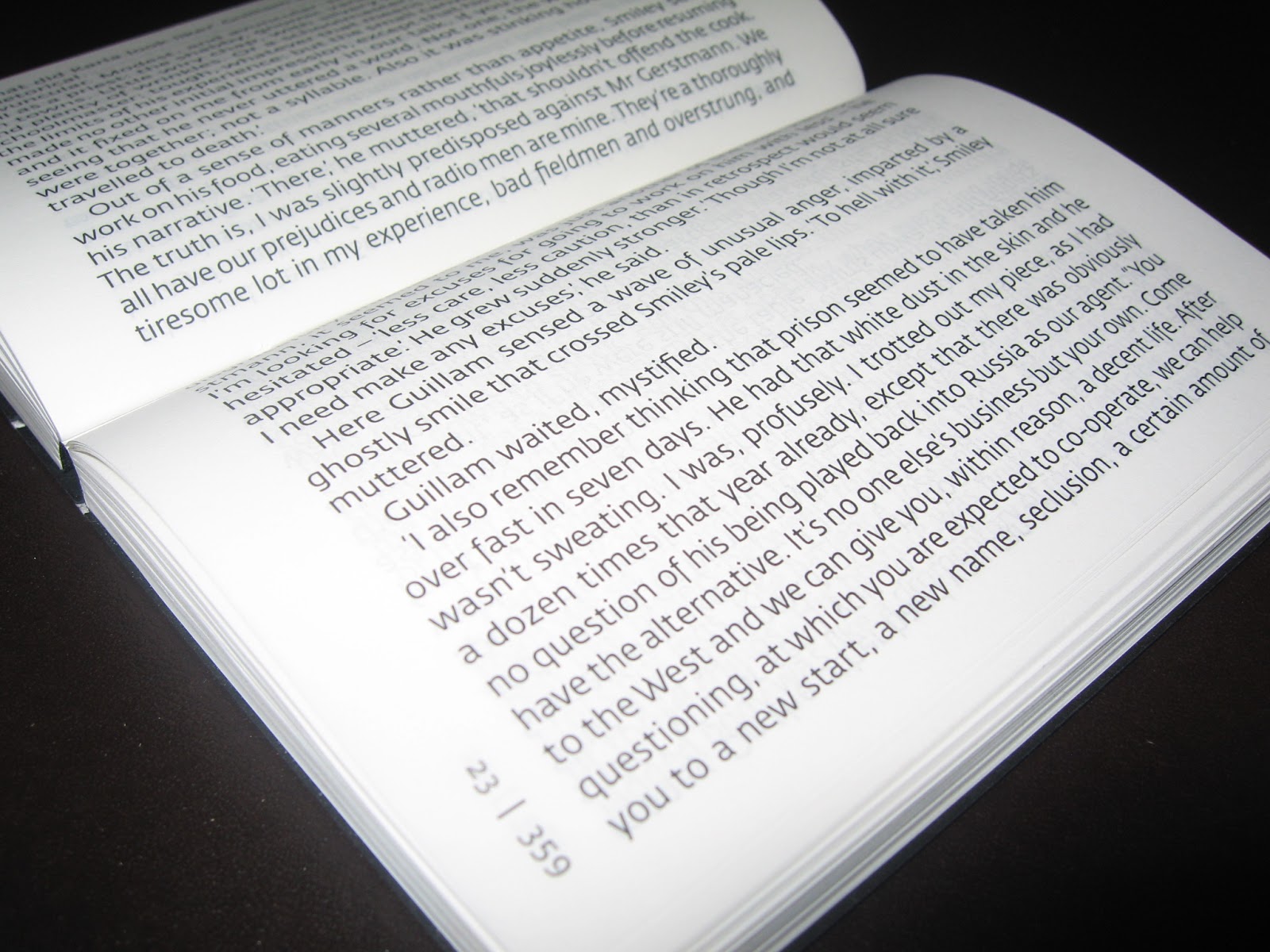
What do I mean? Flip back books. I stumbled across them in my local bookshop, the name front of mind thanks to a great radio marketing campaign. And what a pleasure! All the sensation of a real book, but with half the fat, metaphorically speaking.

A simple innovation of printing a novel with the pages turned bottom to top, rather than the traditional right to left, and the pages made of super-thin paper, allows the book to be truly pocked sized - and smaller than an e-reader, I might add - but retaining all the tactile sensations of a traditional tome.

I picked up le Carré's Tinker, Tailor, Soldier, Spy in this format, not having read it for many years. The flip back book makes the story of George Smiley tracking down the activities of 'Gerald' and 'Lapin' in creating merry havoc in the Circus a real reading pleasure. It's easy to hold one-handed - great format for packed commuter trains, where one free arm's the best you can hope for - and the pages can be turned with the merest push from your thumb, as thin and delicate as a layer of a mille-feuille pastry.

In the book market, anything that provides competition and user choice is welcome, and this new format - sure, a little pricey - adds something new and I take my hat off to the people at Sceptre for taking a leap of faith.

I await with interest news of other thriller writers coming out in this format!

Thursday, 30 June 2011

By George .... they've only gone and done it.

Different actor, same spy

Produce a re-make of a much-loved TV series that is, which, by the looks of it, doesn't make you want to throw away your Kia-Ora and hunker down in front of the small screen. 

Courtesy of the Guardian's website, I've been watching the trailer for the new re-imagining of Le Carré's Tinker, Tailor, Soldier, Spy, starring Gary Oldman as George Smiley.

It's both instantly recognisable, and somewhat different, with the cream of the crop of English actors and a cinematic quality not evident from the excellent BBC mini series. The best bit? The music - monotonous, compelling, hinting at danger, providing the right tone for what looks like a faithful re-imagining.

Wednesday, 22 June 2011

Well, that's the holiday reading sorted ....

Thanks to the good folks of the Harper Collins publicity department, I have received in the post the latest paperback reissues of Len Deighton's books: Close-Up, and the last trilogy of the Samson triple trilogy: Faith, Hope and Charity.

The new introductions by Len are very, very interesting .......

Monday, 20 June 2011

Quick news roundup: palmer, putin, pictures

When not watching Ipcress File, he shoots tigers
Having fifteen minutes to spare for a trawl through the alphabet soup that is the Internet brings up interesting snippets of Deighton and spy-related news from time to time. Today is no exception. Here's a disparate a bunch of items:

First up, according to Michael Caine, the KGB used to learn a thing or two from the silver screen. Across a number of news media is a report from his interview with entertainment newswire WENN (I can't find the original) in which he says a Russian friend tells him Vladimir Putin and colleagues in the KGB used to enjoy the Harry Palmer films! Wonder what tips they picked up? It would be fun to think of trainee spies in the Lubyanka learning how to make a two-egg omelette!

Secondly, a song featuring Harry Palmer and the Berlin Wall has been voted 2 in the top 10 list of Canadian Synth Pop tracks. My favourite was outside the top ten, sadly.

Finally, there's a new book out showing many of the once-though-lost pictures of Brian Duffy, London photographer and co-producer with Deighton of Oh! What a Lovely War. Duffy was an art school contemporary of Deighton's.

Update: a longer article on Caine, drawn from the same newswire source, can be found on the website of the Toronto Sun.

Tuesday, 14 June 2011

All in the detail - Gordon Crabb's covers for Len Deighton

I recently received from Len Deighton a short email containing nine pictures of artwork. More precisely, original cover artworks by artist Gordon Crabb from the 1980s reissues of his works by the Arrow publishing house. And it raised an interesting question: does having an image of the key figures and locations before you start a book shape the way you approach a book and its characters. In other words: who creates the more impactful character - the artist, or the reader? Or does it matter?

First, the artwork. Gordon Crabb's work is of what one might call the 'realist' school: his covers pick out the two or three key characters, in poses and uniforms that suggest instantly their roles, and place them in front of a montage of locations and vehicles which let the reader do an instant join the dots and create a rough and dirty idea of what they're dealing with.

Len tells me of his decision to commission Crabb: "I did nothing other than go through every paperback in Harrods book dept and find that Gordon Crabb's covers were my favorite. After that it was entirely his work. His research was wonderful: he is even more fanatical that I am. He told me that he spent weeks, maybe months, and had to advertise, to get one garment (a riding mac) that was correct for the period. He did about nine covers." Len was supremely confident that Crabb would create covers that spoke to the reader and had a dramatic edge. Interestingly, Len confides: "I never met him." Crabb is nowadays exhibiting as a fine artist.

The covers below (a mixture of original art and the art in situ) are finely detailed and, having read the story, the characters and illustrations are instantly recognisable: with the assassins on the cover of Yesterday's Spy, for example, you can feel your face blasted with the dust blown up by the spinning rear tyre. But here's my question: having seen the front cover, does the image create a character, or rather augment the written word of the author and fix in the reader's mind an image of that character. Does it, in other words, dull the imagination, or inspire it?

I ask because when I first read Berlin Game, Mexico Set and London Match in their original covers, the apple jacket designs by the legendary Ray Hawking were abstract - they hinted at something, riddles you knew would unfold once you opened the covers. Intrigue. Betrayal. Corruption. All in one simple, apple-y metaphor.

There were no characters on display. No gruff Bernard Samson; no sexy, coquettish Tessa Kozinski; no roguish Silas Gaunt. The image I had of these characters was built up page by page, each adjective and adverb adding a layer to the understanding of who that character was. Every reader has his or her own image of the character. So when in 1988, for example, ITV bought to life Bernard, Tess, Silas and others in the TV adaptation, it challenged readers' perceptions of their favourite character. Was Ian Holm really the tall, well-built, bespectacled hero spelt out on the pages of the novel?

Friday, 3 June 2011

Michael Caine and Len Deighton talk Harry Palmer

"At the time I wrote The Ipcress File, the English were even less interested in food than they are now. Any man who was able to cook was regarded as weird." Len Deighton
The 'Harry Palmer' character Len Deighton created - and Michael Caine embodied - was something new when he appeared: the anti-Bond, the tough, uncompromising working class spy who inhabited the shadier streets, someone with whom the cinema-goer could in some way connect. He was also ahead of his time, representative of the changing social behaviour of men in the 'sixties. He could not only cook but - as the scene in which he bumps into Colonel Ross in a new-fangled supermarket, and argued over the tinned champignons, demonstrates - talk knowledgeably about food without appearing to sound 'queer'.

The instant success of this new spy archetype is due in large part to Michael Caine's uncanny understanding of how the modern spy would live and work in swinging London, and portraying that on film. Seducing office colleague Jean with a glass of wine and a home-cooked omelette was something new in the courtship playbook for the average chap. Here was the sixties' 'new man', seducing top notch 'crumpet' and tracking down the spies kidnapping UK scientists.

I recently unearthed a rare copy of Eat Soup magazine from 1996 containing an extensive interview with Michael Caine in which he talks about the overlapping themes of film and food. Eat Soup was the short-lived food supplement for lads' mag Loaded, when it was still a magazine and not the boob-obsessed parody which it's become. As well as the feature interview with Caine, Len Deighton was commissioned to write an article explaining how he used gourmet food and changing cultural fads to help fashion this iconic character. This appears as the post-script to what proves a fascinating Caine interview.

A copy of the full article is now up on the Deighton Dossier main website.

Saturday, 21 May 2011

Reissues go States-side

News today of a deal between Harper Collins and Sterling Partners to reissue most of Len Deighton's books in new editions in the US market.

In August 2011, twelve books by Deighton, including The Ipcress File, Horse Under Water, Funeral in Berlin, Billion-Dollar Brain, Bomber, and Declarations of War, will come out in new editions with new covers (expected to be the Schwartzman covers). These will include the new introductions which Len has written about (and, indeed, as he said in the recent interview with this blog, is still writing).

More information's available on the Booktrade website.

Monday, 16 May 2011

Q&A with Len Deighton - part three

Following yesterday's second blog posting, below is the third and final part of the exclusive Deighton Dossier Q&A with author Len Deighton, in which among other things the author recounts his first steps to discovering what Cold war life was like, behind the Iron Curtain. The questions in this Q&A are either my own or suggestions from blog readers. A full .pdf copy of this interview will be put up on the main Deighton Dossier website.

Len Deighton Q&A - part three

All text (c) Pluriform 2011

Sunday, 15 May 2011

Q&A with Len Deighton - part two

Part one of the Deighton Dossier's exclusive Q&A chat with Len Deighton was yesterday. Now, in part two of the interview below, find out more about how Deighton approached the writing of the immense Samson triple-trilogy, and his feelings on the never re-broadcast TV adaptation of Game, Set & Match.

Deighton Q&A - part two


All text is (c) Pluriform 2011

Saturday, 14 May 2011

Exclusive to the Deighton Dossier: Q&A with Len Deighton


“I didn’t want simplicity. I didn’t want a spot-lit singer on a bare stage. I wanted an opera.”

Len Deighton, on the Game, Set & Match triple trilogy.


Though he spends much of his time in retirement outside of the UK, Len Deighton still visits London regularly and I was fortunate to have the opportunity to catch up with him on a recent visit. Over lunch we talked about his writing past and present, his approach to characterisation - notably the development of the rough-around the-edges Bernard Samson - and setting, his recollections of central London in the ‘sixties ..... and the dipping headlights on his 1978 Cadillac! We also discussed his experiences in the film industry, and he talked positively about the putative Bomber production and hinted at a possible film of Horse Under Water, the ‘missing’ Harry Palmer novel adaptation.

Having failed spectacularly to capture this conversation on my iPhone recorder (see posts passim), I asked Len if he would be willing to do a short interview for the website and blog via email, in the form of the Q&A.

He agreed. The result is this three-part online discussion, based on questions from me and from readers of the blog, the website and the related online forums. Given his infrequent appearances in the UK media, the Deighton Dossier is incredibly privileged to have this opportunity to engage with the author.

Enjoy.

Note: all text is (c) Pluriform 2011

Len Deighton Q&A - part one

Friday, 6 May 2011

A touch of ennui

Nick Jones' interesting book-based blog Existential Ennui (great title) has this week been looking at Len Deighton's 'Harry Palmer' series of books, copies of which he's picked up at various book fairs. Well worth checking out, not least because the blog provides an interesting insight into the motivations and passions of the book collector. Nick's library is certainly varied and, one imagines, large!