Monday, 31 January 2011

Sound of the Cimbalon - on the death of John Barry

The Cimbalon is the twangy, Danubian-sounding harpsichord-type instrument which gave The Ipcress File its characteristic sound, most notably in its main theme 'A Man Alone' (such an apt title, too!).

The man whose cracking idea it was to use it to sum up the tension of Michael Caine's Harry Palmer, an agent out in the field unable to know who to trust and knowing his next move could be his last, was of course composer John Barry, who died yesterday aged 77. Known most famously for his Bond themes and other amazing sound tracks such as that for Born Free, he was clearly an artist who had a knack for crafting a melody that fires the imagination.

As Michael Caine wrote subsequently after the global success of the Ipcress movie:
"If you want to see an example of what music does for a movie, go and see The IPCRESS File. Then you'll understand what John Barry's all about."
Precisely. A very, very talented composer.

A fuller tribute to the man and all his works is found on Armstrong Sabian's ever-excellent Mister 8 blog - go check it out. Also providing thoughts on Barry's influence on the world of Bond is The Double O Section blog.

Friday, 14 January 2011

...Rich man, poor man, beggar man, thief?

Fascinating article in today's Guardian newspaper, looking back on the DVD boxset of the seminal BBC spy series Tinker, Tailor, Soldier, Spy. This adaptation famously starred the late Alec Guinness as spy hunter George Smiley, tracking down the mole at the heart of the 'Circus' (for that, read 'London Central' in Deighton's Game, Set and Match series - the heart of MI6).


It was arguably a defining series in the depiction of the Cold War in popular culture and certainly helped fix author John Le Carré in the canon of spy fiction writers. As reviewer Toby Manning notes, the series is very British and perfectly captures an old school MI:6 before the Internet and Islamic terrorism: "a clutch of pipe-smoking, snobbish, sniggering schoolboys, repressed homosexuality seething through grey strip-lit corridors".

Definitely a series I'd welcome another run at.

As the article points out, the Hollywood remake machine has this cracking drama in its sights: actor Gary Oldman is tasked with taking over the role of the crabby, ageing but ruthless spy-catcher Riley. With Quentin Tarantino's suggestion last year of a remake of Game, Set and Match - not since elaborated on since, of course - perhaps the timing of the Tinker remake points to that fact that sufficient time has lapsed since the Cold War ended for some of the great stories to be revisited and re-imagined for the modern audiences.

Funeral in Berlin? Re-made.

The blood chills.

The classics, I'm afraid, are rarely improved upon.

But, we'll wait and see. What do you think?

Tuesday, 11 January 2011

Muggeridge & Deighton

Happy New Year to all readers of the Deighton Dossier blog!

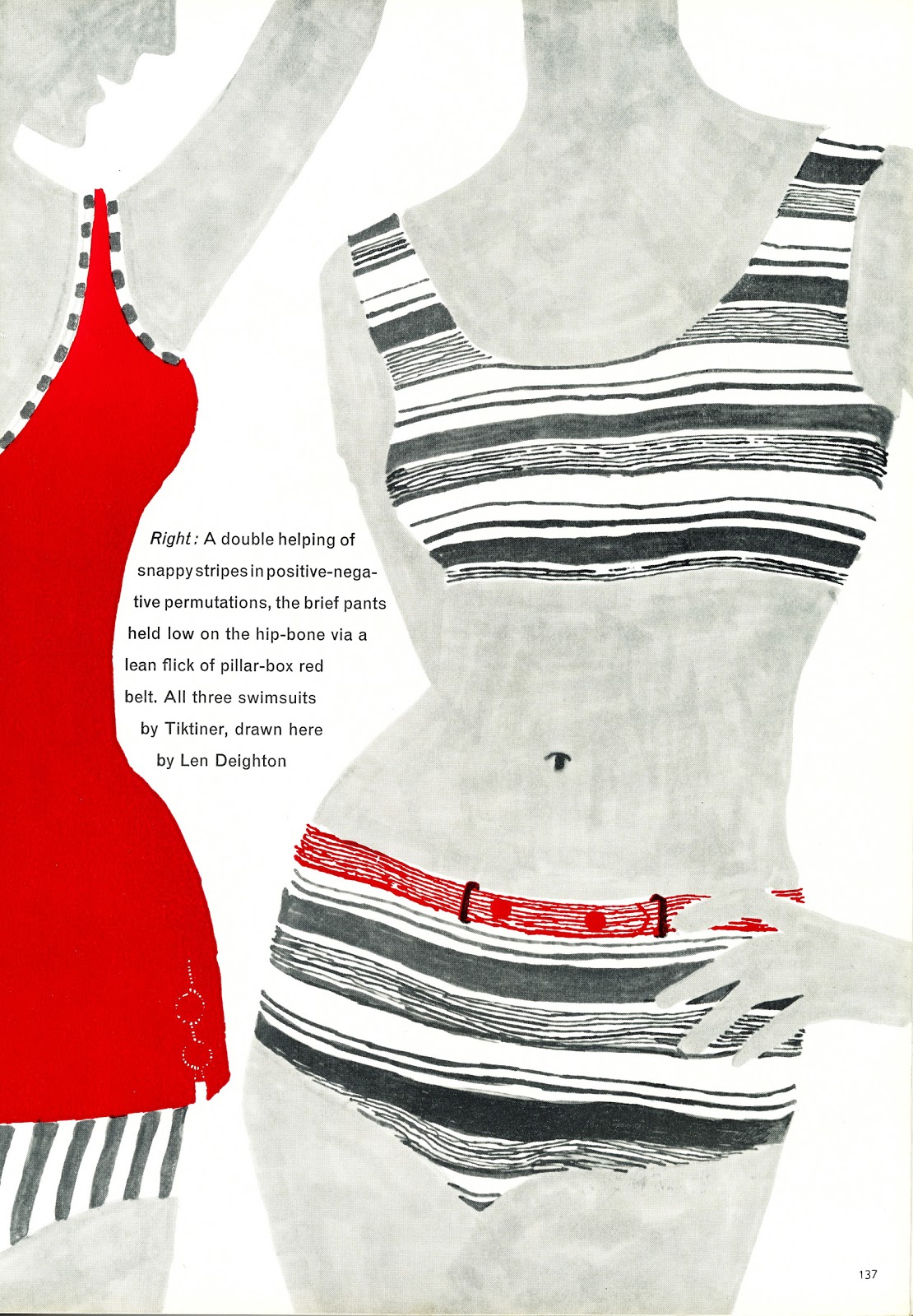
With a new year comes a refresh to the content on the main website which accompanies this blog. In the section on Deighton and design I've created a new page with some fascinating designs he produced for Vogue magazine in 1962, when Deighton was working as a designer while starting to write what became The Ipcress File.

In addition, there's a fascinating interview of Deighton by the late Malcolm Muggeridge, journalist and former intelligence agent during the war, in the short-lived - but entertaining - 'men's magazine, King (think a tame UK version of Playboy). Over five pages the two writers talk at length about the Cold War and spy fiction, the comparisons with James Bond, and the character make-up of the modern spy, all over a menu chosen by Deighton.

A very rare article, which you can download from the website by following the links from the front page.

Sunday, 26 December 2010

Weird internet video #54...

Doing a bit of Boxing Day surfing of the Internet, as you do, I came across this video posted on YouTube:


What to make of it? It's a pretty accurate synopsis of the novel Bomber, as the title of the video implies, but .... well, I can't work out if it's a parody, a skit or some sort of public service video for people who can't be bothered to read a whole book. Great headgear though!

Anyway, take a look, and you decide....

Saturday, 27 November 2010

Do a lot of people know this? Caine on Palmer....

(c) Hodder & Stoughton 2010
I've recently purchased a copy of Michael Caine's new biography, The Elephant to Hollywood (the Elephant in question being a tough suburb of south London called Elephant & Castle). It's a celebrity memoir, so I wasn't expecting anything on a par with say The Moon's a Balloon by David Niven - the yardstick for great actor biographies. But Caine is a good storyteller and his natural south London charm comes across well.

Also, of course, he's the man who brought Len Deighton's spy-with-no-name character - later dubbed Harry Palmer - to life in the 'sixties and - like Sean Connery - changed the depiction of the modern spy on celluloid forever. There are a number of stories in his biography about this pivotal role; some, sure, we've read before, but others which offer new insight into the production and Caine's approach to this role.

Below are some choice cuts from the book.

On The Ipcress File and the naming of the Palmer character:
"The whole point about Len Deighton's anti-hero was that he was deeply ordinary - so ordinary he could always be underestimated. Deighton had never given him a name and that was our first challenge. 'We need something dull,' said Harry [Salzman - the producer of the film]. There was a long silence while we all pondered. 'Harry's a dull name,' I ventured brightly. The silence became very chilly indeed. Harry Salzman gave me a level glance. The room held its collective breath. Harry started to laugh. We all laughed with him. 'You're right,' he said. 'My real name,' he said, turning to me, 'is Herschel. Now for the surname .... Nothing seemed to be right. Harry, as always, had the last word. 'I met a dull man once called Palmer,' he said. And Harry Palmer I became."
Though I'm sure thoroughly burnished over the years by re-telling, it goes to demonstrate that while Harry Palmer so obviously 'works' for the character, the name itself seems to have been a fluke!

On the famous 'cooking scene' in Ipcress File, which was almost nixed by the studio in the US
"After the first rushes, we got a cable from Hollywood. 'Dump Caine's spectacles and make the girl cook the meal - he is coming across as a homosexual.' This is not the exact message - I've cleaned it up a bit - but the implication is clear enough. We had deliberately gone anti-Bond and as well as the glasses, we'd decided that Harry Palmer should be a cook, which was admittedly risky stuff in Britain in 1964, but we made it work. So when Harry goes to a supermarket and pushes his shopping trolley around, it turns into a fight with the trollies as weapons. And when Harry seduces the girl, he doesn't wine and dine her in a fancy restaurant, he takes her home and cooks her dinner - making an omelette by breaking two eggs at once in one hand. (I could see how seductive this could be, but I never mastered it and so in the movie it is writer - and fantastic cook - Len Deighton's hand you see doing the trick."
On filming at the epicentre of Cold War tensions in Funeral in Berlin
"The last time I had occupied the city was in my National Service days in 1951 and it had been a very different place. Now, the wall dividing East and West was an ever present reminder of the Cold War. The East German soldiers watched us through binoculars the whole time we were filming there. At one point they were obviously not happy with the way things were going and shone a mirror at our camera lenses until we had to give up and find another spot."
On being a pioneer as the star of Billion Dollar Brain
"I was very pleased to be playing Harry Palmer again, and I thought - and still think - that Billion Dollar Brain is a really atmospheric movie. It was way ahead of its time, too. I recently discovered that in Billion Dollar Brain I was the first person to use the Internet on screen. At the time I just assumed it was one more piece of technological spy wizardry and back then I certainly couldn't get the hang of it, so I did what all actors do, which is to ask the experts for some emergency coaching, to make me look as if I knew what I was doing."
On the disastrous filming of Bullet to Beijing and Midnight in St. Petersburg
"What I was about to do almost finished me off. The thing is, it sounded really attractive. I was going to work with an old friend. It turned out to be my worst experience ever ..... The filming itself was a joke. The final blow came when we were filming in the LenFilm studio itself. I wanted to go for a pee and they directed me to the toilet. I could smell it fifty yards away and when I got there I found the filthiest toilet I had ever seen in my life. I went outside and pee'd up against the soundstage. So this is where my career had ended, I thought to myself: in the toilet. I'm done."
Having watched both those movies, the image of a rank toilet does seem very appropriate!

The Elephant to Hollywood is published by Hodder and Stoughton and is priced at £20 in the UK.

Sunday, 14 November 2010

The reissues (11) - Spy Hook

Spy Hook - photo (c) Harper Collins
After a blogging hiatus of a few weeks, I'm pleased to get back to blogging about the world of Len Deighton and bring you some news about the latest reissues from Harper Collins. Having brought out new editions of Berlin Game, Mexico Set and London Match, Bomber, Winter, and Len's two most famous cook books, the next off the conveyer belt are Spy Hook, Spy Line and Spy Sinker. All three were reissued this autumn (along with Close-Up).

Spy Hook is the next novel in the nine-volume Bernard Samson series, and follows the tumultuous ending to London Match, which saw Bernard's wife Fiona - now a KGB colonel - outwit him on the streets of Berlin to get rid of a rival and plant further seeds of doubt in the minds of London Central about her husband's position.

Crucially, the action takes place three years on from Fiona's defection. It is evident in this story that those three years have taken their toll on Bernard: though now romantically involved with Gloria Kent from the office, his work has suffered and the hurt of being having been under suspicion by his colleague still eats away at him. Old friend shun him, and he's somewhat 'out of the loop', which for an agent is not a great place to be.

Questions still remain about his wife's defection and, like any good agent, in this novel Bernard starts to pick up the threads of what happened in Berlin and - through a fortuitous meeting with an old colleague in the US - he starts to weave together the strands of what happened to his wife ..... and comes up with a disturbing picture.

We meet a lot of new characters at the start of this trilogy, many of whom the reader will have met in the prequel, Winter, which was published shortly before the second trilogy. Crucially, Bernard stumbles across his old boss, Bret Rensselaer, who was - he thought - mortally wounded in the shoot out that was the denouement of London Match. What Bret has to say makes Bernard question everything that's happened since Fiona defected, and it sets up the next two novels nicely.

The new design
Designer Arnold Schwartzman - long-time friend of the author - has created a tour de force of book design with a design narrative that stretches across all nine books but which gives scope, in each volume, for cover designs that tell a story straight away and hint at the machinations and twists in the novel.

Again, he has used an image of 'Bernard Samson' - for me, it's not how I imagine Bernard to look from reading the texts, but it does provide a strong visual hook and emphasises that Bernard is at the centre of everything (but not always knowingly and often without being in control).

Once again, the Berlin Wall is themed in the front cover and on the images used on the back cover. The reader sees immediately how Schwartzman has "hooked" Samson's image on the sharp end of the hammer & sickle, suggesting - appropriately - the extent to which the character's arc in this story is controlled by malevolent forces on the other side of the wall. Schwartzman writes that the wall image on the front cover was taken at the time when the wall came down, adding a poignant touch.

With the fourth book, Schwartzman's clever touch of using air travel baggage tags to spell out Bernard Samson's name is beginning to take shape. On a bookshelf, with the six books lined up, it creates a visual unity which looks great and emphasises the  scope of these books.

The new introduction
This book stands alone as a story, but also propels along the meta narrative of Bernard and Fiona's relationship and its interlinking to shifts in the operation of the Cold War, in which both are inextricably caught up.

Deighton makes the point in his introduction that, having completed Game, Set and Match, he didn't want to go straight into writing another three books. In fact, he took himself away to write somewhere new, and put aside the existing plans he had for the next books in the novel. It had an effect - he wrote Winter, which I and many other readers regard as essential to understanding the wider Samson trilogy. Deighton explains why that needed to come first:

"I drafted a completely different book that would take a lot of time and energy. I decided that I must complete it before starting the second trilogy. A prequel seemed a valuable addition and almost a necessity. There were so many things I wanted to say about the characters that surrounded Bernard, especially the elderly ones. My story would have to cover a long period .... I decided to call it Winter. Much of Winter was already in my mind as noted extensions of existing characters. Winter [would be] a chronological story but it had to conform to my chart and the overall plan  - and all the biographical characterisations - for nine Samson books."
Deighton makes clear in his notes in this introduction that Spy Hook is about Bernard's shifting relationships with the women in his life - the abandonment (apparently) by his wife and the comfort offered to him by Gloria, who as the story unfolds is demonstrably the one certainty in his life; at least, that is what Bernard thinks.

But this relationship lies heavy on Bernard. This is a story about the impact of guilt, Deighton says, about Samson's domestic situation. It leads him to question everything and to try to get to the root of what really happened in Berlin. As Deighton writes:
"It becomes essential for Bernard to believe his wife is not only a defector but personally dishonest and disloyal and thief too. Only by proving this to his master and to himself will Bernard be able to shed, or at least be able to soften, the deep feelings of guilt he has about being in love with the much younger, and sometimes childlike, Gloria. It is the depth of his love for Gloria that makes his quest so important to him."
Spy Hook is where the Samson series goes to another level and becomes more than just a spy story. It is a multi-level, multi-character examination of human weakness and frailty, set against the last years of the Cold War.

Monday, 1 November 2010

Caution: Slow blogging

Readers to the blog will notice that posting's been a little slow of late. This is mostly due to my purchasing a new home and dealing with all that goes with it.

Normal service will be resumed shortly, where I'll have reviews of the three latest reissues from Harper Collins and a fascinating archive magazine feature by Deighton.

Friday, 15 October 2010

New competition - win a first edition of Mike Ripley's Angels Unaware

Author Mike Ripley - creator of the award-winning crime series starring detective Ray Angel - is known to this blog through his books and his column on crime, spy and thriller writing which he writes on the Shotsmag website, called 'Getting Away with Murder'. As readers will see from the previous blog post, his friend Len Deighton has provided a guest blog on this month's edition of the column.

Someone once described Ripley as a writer who writes 'like a young Len Deighton, wierd and wonderful information and very, very funny'. He's also been described as 'England's funniest crime writer' by The Times and he is also a respected critic of crime fiction, writing for the Daily Telegraph, The Guardian, The Times and the Birmingham Post among others.

Ever generous, Mike has donated a signed first edition hardback copy of his latest novel, Angels Unaware. This book follows the adventures of his celebrated character Fitzroy Maclean Angel, who is not your ordinary private detective. In this new comedy crime thriller, the world he inhabits is strange and it is about to get stranger. A new born baby means no more cases, no more fingerprinting and no more espionage and, with the arrival of his aging, hippy mother, he has swapped bloodstains for paint stains. Domesticity, or the lack of it, has replaced his high-paced, crime-solving lifestyle. That is, of course, apart from the AWOL screenwriter whose mother's funeral he must attend.

I've just started reading another copy of this book and it's already proving a great page turner on the train into work each morning, following in the tradition of the Angel series of stories.

For a chance to win this signed copy of the book, answer this (ridiculously easy) question:

On the front cover of this book there is a supportive review quote from author Colin Dexter. For creating which fictional detective is Colin most noted?

Please email your answers through the blog or to me directly by the 4th November 2010. A winner will be picked at random from all the correct answers. This competition is open to international readers of the Deighton Dossier Blog, the numbers of which, judging by the little map on the side of blog, are increasing every week. No correspondence will be entered into concerning this competition
______


Update: we have a winner: Bill Creed of the USA. The correct answer was, of course, Inspector Morse. Thanks to all of the readers of this blog who took part.

Saturday, 2 October 2010

Len's Shots Mag appreciation of Ray Hawkey

Well done to author Mike Ripley who's arranged for his friend Len Deighton to pen a short blog post on the late Ray Hawkey in the latest edition of Getting Away With Murder, on the Shots website.

Deighton, who seems in fine fettle judging by the recent photo included, talks about the wonderful designs and innovations Ray brought not only to his works, but also to other novels. The extent of that detail is bought home in the story about the miniature champagne bottles used to market Close-Up to book sellers. I thought I knew pretty much everything about all the ephemera associated with Deighton's books, but this was a new one for me.

Saturday, 25 September 2010

Monday - CBC documentary on Len Deighton

Earlier this year I spent a day with radio producer Philip Coulter from the Canadian Broadcasting Corporation's Ideas programme, a long-running radio documentary programme. He was interviewing Len Deighton for a profile which looks at his career and in particular at the themes of human loves and fears, and office politics too, which drive the world of espionage in Len's novels.

Philip approached me, as the creator of the Deighton Dossier website, to contribute my thoughts to this programme which I was glad to do. We spent a morning walking around London chatting about Deighton's books and characters in the locations where some of the great scenes in the book take place.

[Update]

The profile was very interesting. Philip interspersed selections from his interview with Deighton with readings from Game, Set and Match and contributions from me from our day-long walk around London. I think it came across quite well, and there were some interesting new insights from Deighton about his approach to writing the book and his motivations behind the creation of the iconic Bernie Samson character. Also touched on was his views on the English class system, on the motivation of spies and his approach to writing.

Blog readers should check out the Ideas website. The show was broadcast on Monday evening, 1930h Canadian time, on a number of digital channels; it can also be found on listen again on the CBC website. The programme also has a podcast, so it should be possible for readers to listen to the programme in one way or the other.

If you listened to it and enjoyed it, share some of your thoughts on the Deighton Dossier forum or in the comments section of this page.

Saturday, 18 September 2010

Four eyes better than two

Interesting little article in the Daily Telegraph yesterday. The journalist - with the delightfully exotic name of Henry de Quetteville - opines on the possible demise of spectacles not just as a solution to myopia but as a part of everyday life, and popular culture too. In it, he picks up on the image of Michael Caine as Harry Palmer in the three films from the sixties and the iconic status of his tortoiseshell glasses. Though not explicitly referenced in the books, Caine's decision to wear these glasses (he was short-sighted) in the film turned a character into an icon, such that's it's difficult to disassociate the books, the character and the films from the glasses, to a large degree.

What did it signify, back then? This was a spy with imperfections. A man who, after making love to a flighty young dolly bird had to reach across to his bedside table to grab his specs before he could make a cup of coffee (recall the use by director Sidney Furie of shots of the main character shot through his own glasses). Someone who gave the appearance of an upper working class clerical officer who was able to bump off Eastern Bloc's finest. He was an everyman spy to the like the cinema-going public in the sixties; they could be him. Bond, in contrast, was the escapist fantasy, the public school educated hero and action man.

All through what was effectively a simple choice of costume!

Saturday, 11 September 2010

Michael Caine on the erroneous return of Harry Palmer

(c) Ian Derry
Interesting article in the Daily Mail this weekend - a long career retrospective interview with 78-year-old Michael Caine, film star and English hero.

The piece, written by Caine, talks about some of his struggles in the middle part of his career when great characters started to dry up and his career was at a crossroads ... which his decision to film On Deadly Ground with martial arts champion Steven Seagal in 1994 did little to address.

The year after, during this career slump, he talks about revisiting an old friend - his character of Harry Palmer, which he'd made internationally famous in the sixties with The Ipcress File, Funeral in Berlin and Billion-Dollar Brain.

Interestingly, Caine says his decision to go back over old ground "almost finished me off". Some interesting experiences with the local Russian Mafia and the Russian security forces had Caine questioning quite what he was doing:
"The filming itself was a joke. The final blow came when we were shooting in the Lenfilm studio itself. I wanted to go to the toilet and they directed me to it. I could smell it 50 yards away and it was the filthiest lavatory I have ever seen."
That seems an appropriate reference. Both Bullet to Beijing and Midnight in St. Petersburg are pretty poor films, and not a great legacy in light of the earlier masterpieces which put Deighton's unnamed spy on a cinematic par with Bond.

Though billed as Len Deighton's Bullet to Beijing, the film script was written by Peter Wellbeck and, of the two movies, this is the better, though both are dragged down by Jason Connery's wooden acting (his performance giving the lie to the idea that star quality passes down in the genes).

Len Deighton is involved as a co-writer of the script for Midnight in St. Petersburg, though the idea is not based on any existing Len Deighton novel. There is ample evidence to suggest that much of Midnight in St. Petersburg is cobbled together with edited-together out-takes from the earlier Bullet to Beijing filming, and the storyline is definitely threadbare.
 
Midnight in St. Petersburg, is actually a made-for-TV movie was produced for a pay-TV channel in the states, Showtime, part of the deal with Caine being that he would only make it if the big-budget movie - Bullet to Beijing - was made alongside it. It shows - it has the feel of a straight-to-cable movie.

The nature of this deal gives an idea of where Caine's career was at the time. Not in a great place. Possibly at an end. But as the rest of the article recounts, thereafter Caine saw an upswing in his career with meatier roles leading up to his Oscar winning performance in The Cider House Rules in 1998.

Very interesting article.

Friday, 10 September 2010

Bits and pieces for your delectation

Every once in a while browsing the Interweb I stumble upon articles referencing Len Deighton and the related world of spy espionage. Sometimes, too, readers send me links to interesting some if the farthest reaches of the World Wide Web.

I found two articles from The Guardian newspaper in the UK.  The first is a short piece from the lifestyle section on blenders. Yes, blenders - the electric kitchen utensil. The Deighton connection? Well, his dismissive reaction to these new gadgets in the 'sixties - recorded in his Action Cook Book - opens the piece. Of more direct Deighton interest is this review from last year, when that self-same book was republished - with much success - by Harper Collins. Cooking columnist Rachel Cooke - one of the journalists who last month put Action Cook Book at #44 in the all-time best cookbook list in The Observer - reviews this pioneering gastronomic guide for guys.

As well as being insightful, beautifully designed and promising the best meal of her life, the book "contains a very reassuring, no faffing, recipe for Béarnaise sauce".

Thursday, 2 September 2010

Le Carre on Philby

(c) Paul Calver for Sunday Telegraph
I've read online today an interesting interview with David Cornwall - better known by his literary alter ego John Le Carré - in which he recalls his decision not to meet Kim Philby, the Soviet spy of Cambridge spy ring fame who, the article recalls, no doubt played a part in ending Cornwall's career in MI:6 and MI:6.

The Sunday Telegraph magazine article reveals the depth of contempt the writer feels for Philby. Offered the opportunity in the late eighties to meet with the famous double agent, Cornwall recalls his disgust at the prospect of meeting a man responsible for the demise of British agents:
'"I couldn’t possibly have shook his hand,’ he shudders. ‘It was drenched in blood. It would have been repulsive. Lord knows how many agents Philby betrayed. They were tortured in terrible ways.'"
This is a very long and detailed interview with the author - timed as part of the PR push around his new novel 'Our Kind of Traitor' - and it reveals a number of interesting anecdotes about as well as some familiar and unfamiliar tales about his childhood. His new novel is based in Russia and draws on the world of the Oligarch, inspired by a meeting Le Carre had with a big-time crook Dima just at the end of the Cold War:
‘After a long wait, Dima, flanked by a bevy of heavies and a posse of pretty, pouty, scantily clad young women, deigned to arrive. He was a big monster of a man who looked like Telly Savalas.’
Fascinating portrait of one of the collossi of British espionage writing.

Tuesday, 31 August 2010

Raymond Hawkey obituaries

(c) TOPFOTO
Two obituaries for the late Raymond Hawkey - whose death was covered last week on this blog and referenced elsewhere across the blogosphere - have appeared in today's papers, in both The Guardian and The Daily Telegraph. Both obituaries use the same photograph - reproduced here - of Hawkey in what I guess is the late sixties or early seventies, sitting aside some modernist designer furniture and demonstrating his impeccable dress sense which is remarked upon in both obituaries.

Both obituaries are well written and respectful portraits of a contemporary and lifelong pal of Len Deighton who in his own way made as much an impact on the 'sixties through his pioneering design work in publishing - particularly through The Ipcress File cover and later on the Pan Bond editions - and in newspapers and magazines, shaking up the media establishment with his introduction of photo realism and a new graphical approach to typography and illustration. His influence is still seen in the papers we read every day.

Len Deighton himself penned his own tribute in Sunday's Observer newspaper to a man who had been his friend since the fifties. "It was a great privilege to be Ray's friend", he writes. As there is no url link currently available on The Observer website, a copy of said article is reproduced below as an image.

(c) Guardian Media Group

A touching, personal note on an enduring friendship.